Showing posts with label Tudor. Show all posts

A Thought for Edward VI on a Difficult Day for Him

by Janet Wertman

Despite his enormous promise, Edward VI was a tragic figure, on so many levels.

The first level involves the wrongs his father did to get him. Henry VIII firmly believed he needed a male heir. When his first wife, Catherine of Aragon, proved unable to fulfill this obligation after twenty years of marriage, Henry abandoned her. That the Pope disagreed didn’t matter – Henry abandoned the Catholic Church as well, founding the Church of England to seal his right to remarry. Then when Henry’s second wife, Anne Boleyn, birthed only a daughter and experienced several miscarriages, Henry had her executed on trumped up charges to pave the way for the third wife who would finally give him the son he craved. Jane Seymour, Edward’s mother, is often said to have “walked through Anne’s blood” for her title. In Jane’s defense, we must remember that she paid for the privilege with her life.

The second level involves the circumstances of Edward’s youth. His mother died in childbirth, and his first two stepmothers were little involved in his life. Edward got lucky with his third stepmother, Katherine Parr, who finally gave the five-year old prince a real experience of family life. Life further opened up to him as other children were brought into his household to share his life and his education.

Barnaby Fitzpatrick, the son of an Irish peer, became his whipping boy (since Edward’s teachers could not in good conscience administer corrective beatings to “this whole realm’s most precious jewel”). Still, the fear that surrounded the young prince must have been oppressive: Henry was terrified that something would happen to his only son. Very few people were allowed to visit Edward’s household out of fear of the plague. All of his food was tasted. Every servant was schooled in the rigorous standards of security and cleanliness that Henry imposed. Such constant caution would inevitably be deeply internalized.

Even when Edward acceded to the throne, things did not improve by much. He was so young, only nine years old. This is wonderfully captured in many of the unintentionally poignant entries in his Chronicle (which was, in the words of Wilbur Kitchener Jordan, “in part private diary, in part an educational exercise, and in part considered notes on policy and administration”), like the one he wrote about his coronation, in which he proudly described how he had dined with his crown on his head. Yet the real power belonged to his uncle, Edward Seymour Duke of Somerset, who was named Lord Protector to rule while Edward was still a minor. Importantly, this went against Henry VIII’s wishes – Henry hadn’t wanted anyone to be in a position to divert power from his son: he had envisioned a “Regency Council” that would rule collectively. Nevertheless, Somerset was able to quickly seize control thanks in large part to a last-minute “unfulfilled gifts clause” added to Henry’s will under the dry seal that allowed the executors to distribute lavish gifts to their friends.

Unfortunately, Somerset was not as respectful of his young nephew as he should have been. Somerset was proud and self-interested and kept the young King dependent on him for as much as he could. This encouraged Somerset’s younger brother, Thomas Seymour, to hatch a scheme to replace Somerset as proxy ruler. In the middle of the night on December 16, 1549, Seymour tried to break into the sleeping King’s apartments at Hampton Court Palace. He made it into the privy garden (he had keys), but one of the King’s pet spaniels started barking. Seymour shot and killed it, which brought guards running. There was no defense for being outside the King’s bedroom in the middle of the night with keys and arms – and using them both. It was alleged that Seymour’s plan was to kidnap the King, perhaps force him to marry Lady Jane Grey (Seymour’s ward); this was treason enough. It was suspected that he might himself marry the King’s sister Elizabeth then kill the King and seize the throne. There could be no mercy. Thomas Seymour’s was the first death warrant that Edward VI had to sign, and today is the anniversary of Seymour’s execution (a topic I have covered in a companion post on my own blog, I hope you’ll visit!).

And as if sentencing one uncle to death wasn’t bad enough, less than two years later the not-even-fifteen-year-old King had to do it again. John Dudley, Earl of Warwick, engineered a coup d’etat against Somerset. The charges were less clear than the ones against Thomas Seymour, but no less deadly. Edward himself summarized them in his Chronicle as "ambition, vainglory, entering into rash wars in mine youth, negligent looking on Newhaven, enriching himself of my treasure, following his own opinion, and doing all by his own authority, etc." Although Somerset survived this plot, he tried to fight back against Warwick (who had by then become the Duke of Northumberland) – and lost. That was fatal. To use Edward VI’s own words again, on January 22, 1552 "the duke of Somerset had his head cut off upon Tower Hill between eight and nine o'clock in the morning".

The next year was a good one for Edward VI – Northumberland made every effort to incorporate him into the running of the government. But then the young King fell ill from what is now believed to have been tuberculosis. As death approached, the fervent Protestant grew terrified at the idea that his staunchly Catholic sister Mary would inherit his throne. He created his own Devise for the Succession which bypassed both his sisters, Mary and Elizabeth, and settled the crown on his cousin, Lady Jane Grey. It is not clear whose idea this was, but we do know that Northumberland stood to benefit greatly from this arrangement: Lady Jane Grey was married to his son. Regardless, the Devise failed when England rallied behind Mary as the next rightful heir (in case you were wondering, Northumberland was the first person executed during Mary’s reign).

Tragic all around.

***

SOURCES:


Wilbur Kitchener Jordan, England’s Boy King: The Diary of Edward VI (1966)

Wikipedia, Luminarium

***

Janet Wertman is a freelance grantwriter by day and a writer of historical fiction by night. She is currently working on a novel of Jane Seymour, Henry VIII’s third wife, which is expected to be released in 2015. She regularly blogs about the Tudors and what it’s like to write about them – please visit her website:  www.janetwertman.com.

Sing a Song of Sixpence - A Nursery Rhyme, a King and Queen, and a novel.

Judith Arnopp


Sing a song of sixpence a pocket full of rye,
Four and twenty blackbirds baked in a pie.
When the pie was opened the birds began to sing,
Oh wasn't that a dainty dish to set before the king?
The king was in his counting house counting out his money,
The queen was in the parlour eating bread and honey
The maid was in the garden hanging out the clothes,
When down came a blackbird and pecked off her nose.

There are many theories as to the origins of the nursery rhyme Sing a Song of Sixpence. Some see it as an early lampoon about the extravagances of royalty, some as a representation of Henry VIII, Katherine of Aragon with Anne Boleyn playing the part of the maid. The blackbirds baked in the pie being the disaffected monks after the dissolution of the monasteries.

One account I stumbled across equated it with the pirate Blackbeard as ‘a coded message that evolved over several years and was used by confederates of the notorious pirate Blackbeard to recruit crew members for his prize-hunting expeditions.’
There is much more about Blackbeard here: http://www.snopes.com/lost/sixpence.asp

I tend to prefer the Tudor links to the rhyme for although Sing a Song of Sixpence was first published in the 18th century it certainly has origins in the 16th. Perhaps sixpence was the going rate for a good song during this time. There are references to singing for sixpence in Shakespeare’s Twelfth Night during a drunken conversation between Sir Toby Belch and Sir Andrew.

 “SIR ANDREW: Excellent! Why, this is the best fooling, when all is done. Now, a song.
SIR TOBY BELCH: Come on; there is sixpence for you: let's have a song.” (Twelfth Night, Act II Sc. III)


Elizabeth of York
Of course, no Tudor banquet was complete without minstrels to play the favourite songs. One can easily imagine the king and queen seated with their court at groaning tables, dining on exotic dainties to the strains of fabulous music.

In the Tudor period (and certainly before that) extravagant dishes were created to amaze and enthrall the king. Swans and peacocks were roasted and the feathers then replaced to make it appear the birds were still living. Dishes such as dolphin and porpoise were not unheard of and, with recipes like these, one can imagine the chef’s unenviable task of thinking up new and innovative ideas to tease the royal palate. Song birds were regularly eaten, it is only one step further to serve the dish a little al dente. Why not a pie full of live birds?

It wouldn’t have been so unusual. An Italian cookbook from 1549 contains a recipe ‘to make pies so that birds may be alive in them and flie out when it is cut’. (See note 1)

A description of the wedding of Henry IV of France and Marie de Medici says, ‘The first surprise, though, came shortly before the starter – when the guests sat down, unfolded their napkins and saw songbirds fly out.’ (See note 2)

One version of the rhyme was published in Tom Thumb’s Pretty Song Book in around 1744. Instead of four and twenty black birds it has four and twenty ‘naughty boys’ beneath the crust.    

  Sing a Song of Sixpence,
  A bag full of Rye,
  Four and twenty Naughty Boys,
  Baked in a Pye.

 What else, one wonders, would you do with twenty four disobedient children?

Eating bread and honey
Personally, I was taught as a child that the king and queen concerned were Henry VII and Elizabeth of York. (Incidentally, Elizabeth also graces the playing card and the likeness to her contemporary portraits are quite clear.) Henry Tudor is often depicted as being ‘careful’ with money and so fits quite well within his 'counting house.’ Whether this idea of kingly miserliness originates with the poem or vice versa it is not possible to say. His taxes were unpopular enough for the Cornish to rise in arms against him. (Mind you, that is not at all unusual, people never like to pay tax.) But, miserly or not, his careful control of his finances meant that at his death the royal coffers were full; he would likely have turned in his grave if he’d known how quickly and thoroughly his son, Henry VIII, was to empty them, squandering his father’s riches on war and theatrical gestures.

Elizabeth of York took no part in governing the country; her role was purely a domestic one, concerned with the children and charitable works; so again, the positioning of her in the rhyme eating bread and honey in the parlour is in keeping. 

 In my forthcoming novel A Song of Sixpence Elizabeth is not depicted scoffing bread and honey in the parlour; instead she is battling to come to terms with the loss of the primary male members of her family and preserving her surviving kin from a similar fate. Her marriage to the former enemy Henry VII is difficult and not helped by the appearance of a man claiming to be her brother, Richard of York, thought to have perished in the Tower in 1483. A man that Henry dubs Perkin Warbeck.

In literature Elizabeth is most often  presented as a daughter, wife or mother,. She has become as two dimensional

as the image on the playing card. But she was a real woman, with real emotions, who lived in very turbulent times. I wanted to put some flesh on her bones, some thoughts in her head and give her some of the credit she is due.


And the same for Henry. In both fiction and non-fiction he is either a cold calculating king or a complete monster. In A Song of Sixpence he is painted many shades of grey (no, it isn’t that sort of book). He is by no means an easy husband for Elizabeth for his years of exile have left him with insecurities and a chip on his shoulder that threatens both his marriage and his throne. His reign suffered more uprisings than any other; he can scarcely have enjoyed a quiet moment, but Elizabeth was raised to be dutiful and ultimately proves a good wife, a good queen, and an exemplary mother.

~~~~~~~~~~~~~

A Song of Sixpence: The story of Elizabeth of York and 'Perkin Warbeck.' 

In the years after Bosworth, a small boy is ripped from his rightful place as future king of England and forced to roam the courts of Europe. His sister Elizabeth, now Queen to the invader Henry Tudor, is torn between family loyalty and duty.

As the final struggle between the houses of York and Lancaster is played out, Elizabeth is torn by conflicting loyalty, terror and unexpected love.

Set at the court of Henry VII A Song of Sixpence offers a unique perspective on the early years of Tudor rule. Elizabeth of York, often viewed as a meek and uninspiring queen, emerges as a resilient woman whose strengths lay in endurance rather than resistance.

A Song of Sixpence is available to pre-order for your UK Kindle NOW; if you are in the USA, click here.

You can read more about Judith and her work on her website:  
And purchase her books, both in paperback and on Kindle here.


Illustrations for Wikimedia commons.
http://upload.wikimedia.org/wikipedia/commons/8/8f/Sing_a_sing_of_sixpence_-_illustration_by_Walter_Crane_-_Project_Gutenberg_eText_18344.jpg
http://upload.wikimedia.org/wikipedia/commons/2/22/Elizabeth_of_York_from_Kings_and_Queens_of_England.jpg
http://upload.wikimedia.org/wikipedia/commons/e/e5/Prinsep%2C_The_Queen_was_in_the_Parlour.jpg
http://upload.wikimedia.org/wikipedia/commons/9/92/Four_and_Twenty_Blackbirds.png
http://upload.wikimedia.org/wikipedia/commons/d/df/Queen_of_Hearts_%28Elizabeth_of_York%29.png

Notes 
1: (Giovanni de Roselli's Epulario, quale tratta del modo de cucinare ogni carne, ucelli, pesci... (1549), of which an English translation, Epulario, or the Italian Banquet, was published in 1598 (Mary Augusta Scott, Elizabethan Translations from the Italian no. 256, p. 333f.)

2: (Blow out! History's 10 greatest banquets - Features, Food & Drink - The Independent)

Elizabeth of York - Mother of a Dynasty

by Judith Arnopp

Elizabeth of York
All images rom Wikimedia*
Unlike her son Henry VIII and the granddaughter named in her honour, Elizabeth of York isn’t a household name. When viewed against the back drop of other Tudors she is far less splendid than her children; she is conventional and appears obedient, even cowed perhaps. Her portraits show a pretty, plump, and resigned looking woman who doesn’t adhere to our imagined picture of the mother of a king, the grandmother of a king and two queens. But, although her meek expression belies her harsh experiences she was in fact, the founder of a dynasty.

Elizabeth was born on February 11th 1466 into the bloody era now known as the Wars of the Roses. She was the first child of Edward IV and Elizabeth Woodville. To everyone but the couple involved, this was an unconventional and unpopular match but, unlike other queens, Elizabeth Woodville was to prove satisfactorily fertile.

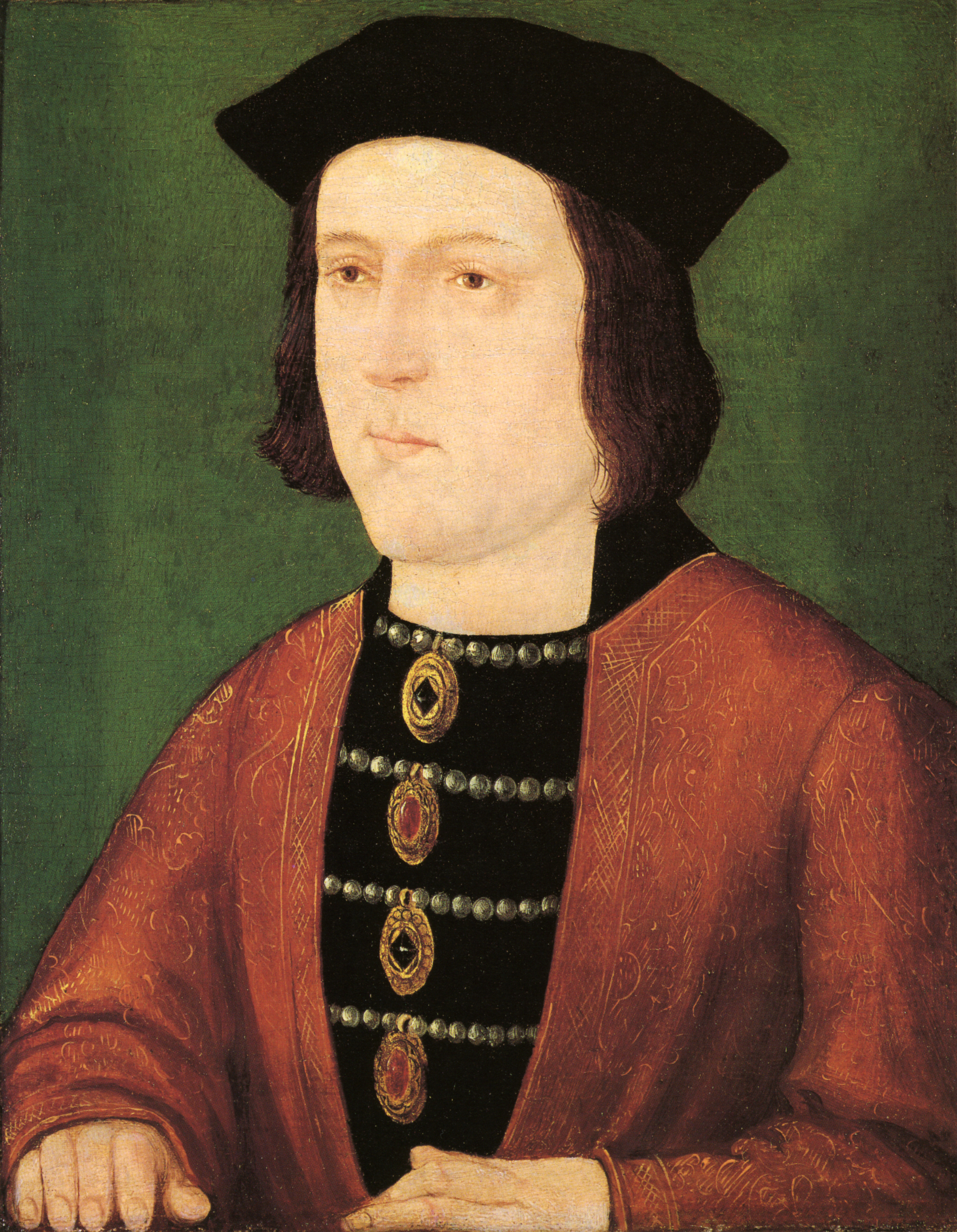
King Edward IV
It was a time of upheaval and when Edward was forced to flee into exile in Burgundy, the Queen, along with her daughters, fled into Sanctuary at Westminster Abbey.  There, safe from conflict but estranged from the exiled King, the first of the younger Elizabeth’s brothers was born. (The boy Edward would later earn his place in history by ‘disappearing’, along with his brother Richard, from the Tower of London, igniting a mystery that continues to burn today.)

Meanwhile, boosted perhaps by the good news, the exiled king gathered his forces and with the aid of his brother-in-law, Charles the Bold of Burgundy, returned to England to resume the battle for his throne, finally defeating Warwick and Margaret of Anjou and having the old King Henry VI murdered in the Tower. This initiated a time of relative peace.

For Elizabeth, now five or six years old, it was time for her education to begin. As well as the skills of running a huge household, she was also taught to read and write and given some instruction in accounting. Contemporary reports describe her as pious, obedient, and loving, and dedicated to helping the poor.

In 1475 when Edward made his peace with France, it was arranged as part of the treaty that on her twelfth birthday she would go to France to prepare for marriage to Dauphin Charles. But, before this could take place, France reneged on the deal and married his son to Margaret of Austria instead.

Elizabeth Woodville
Things ran smoothly for a while, or as smoothly as they ever do in royal circles, until, on the unexpected death of the King in 1483, Elizabeth fled once more with her mother into Sanctuary at Westminster. Richard of Gloucester took his place as Lord Protector and Elizabeth's brother, the Prince of Wales, was brought to London to await his coronation, as was tradition, in the royal apartments at the Tower. 

Shortly afterward it emerged (whether true or not is another question) that Edward IV’s marriage to Elizabeth Woodville was bigamous due to a prior contract of marriage. All children of the union between Edward IV and Elizabeth Woodville were pronounced illegitimate. As we all know, Gloucester was declared King Richard III, and at some point between 1483 and 1485, Elizabeth’s brothers disappeared from the record. (That is not proof however that they disappeared from the Earth – there are any number of possible explanations).

The Princes in the Tower
How must this have been for Elizabeth? One moment she is the Princess of the realm, Dauphine of France, and the next an illegitimate nobody living in exile from court in the squalor of sanctuary.

And what of her brothers' fate? She would have been ignorant of that, and the resulting uncertainty mixed with grief for her father can only have been hard. It is possible that her mother knew or believed the boys to be safe. Why else, after scurrying into the safety of Westminster in fear of her life, would she suddenly hand her daughters into the care of the very man suspected of injuring her sons? 

We cannot know the answer to that, but the uncertainties provide very tasty fodder for the authors of fiction.

Elizabeth and her sisters returned to court to serve Richard’s Queen, Anne Neville, where they were treated with every courtesy. Queen Anne was ailing and clearly dying. It was at this time that rumours emerged of a relationship between Richard and his niece, Elizabeth. It is now impossible to be certain of the truth behind the allegation, but at the time gossip was strong enough for Richard to publicly deny the accusation. Whether the claim was true or not, Elizabeth would have suffered some degree of shame, but she seems to have continued to be prominent at court, serving the Queen until her death in March 1485. 

In August, when invasion was looming, Elizabeth and other children from the royal nursery were sent north for safety while the King dealt with the threat from Henry Tudor.

Henry Tudor
Henry Tudor, the Lancastrian heir, was aided throughout his exile by his mother, Margaret Beaufort in England. Margaret had devoted her life to her son’s cause. She  untiringly devised methods to secure the throne she saw as rightfully her son’s. Prior to his invasion, in order to muster support from the Yorkist faction, Henry promised that, if he became king, he would marry Elizabeth of York and unite the warring houses of York and Lancaster, putting an end to the Wars of the Roses forever.

After Richard III’s defeat at Bosworth in 1485 Elizabeth was taken to Margaret Beaufort’s house at Coldharbour, but Henry was slow to marry her and slower to crown her. We should consider the logistics of arranging a royal wedding at short notice, but it not something that Henry VIII found an obstacle in the next reign. To some it is almost as if he wished to deny that Elizabeth had any influence on his claim at all. They were married in January 1486. Elizabeth gave birth to their first child, a son whom they named Arthur, in September of the same year scarcely nine months later. She had no further children until two years after her coronation which took place in November 1487.

Perkin Warbeck
Henry Tudor’s reign was fraught with rebellion. Pretenders emerged throughout, some were swiftly dealt with, but one in particular, Perkin Warbeck, claiming to be Elizabeth’s younger brother, Richard, harried the king for years. We will never know his real identity, although the King went to great lengths to provide him with a lowly one.

Elizabeth is always described as a dutiful wife and devoted mother. She took no part in ruling the country, and there are no reports of her ever having spoken out of turn or ‘disappointing’ the King. Henry appears to have been a faithful husband; his later relationship with Katherine Gordon, wife of Warbeck, was possibly no more than friendship, but Katherine did very well, both in status and financially, at Henry's court.

Although Prince Arthur was raised, as convention dictated, in his own vast household at Ludlow, Elizabeth took an active role in the upbringing of her younger children, teaching them their letters and overseeing their education.

Prince Arthur
When Arthur, the Prince of Wales, died suddenly in 1502, both Henry and Elizabeth were distraught, the King thrown into insecurity at having been left with just one male heir. Reports state that the King and Queen comforted each other and, although there are some hints of a possible estrangement between the royal couple, Elizabeth promised to give Henry another son. She fell pregnant quickly and, ten months later, gave birth to a girl, Katherine, but succumbed to puerperal fever and died on her birthday, 11th February 1503.

Elizabeth of York
Elizabeth deserves more credit. There is as much strength in resilience as in resistance, and I believe she was both strong and resolved, bound by duty to serve her country as best she could.

Her union with Henry negated the battle between York and Lancaster, and the many children she bore strengthened political unions with France, Scotland, and Spain. Ultimately, she died doing her duty to England.

When a king puts aside personal desire for the sake of his country or dies on the battlefield defending it, he becomes a hero; often, if he is on the right side, he is honoured throughout history.

Yet Elizabeth did all those things. She married dutifully; she quickly produced an heir, a spare, and several daughters to increase the king’s bargaining powers. At the tragic loss of the Prince of Wales, despite her age and the suggestion of medical problems, she took the most dangerous decision to try to give the King another son. She died a hero, in service of her King and country.

Images:
*http://upload.wikimedia.org/wikipedia/commons/9/95/Elizabeth_of_York_from_Kings_and_Queens_of_England.png
http://upload.wikimedia.org/wikipedia/commons/4/48/King_Edward_IV.jpg
http://upload.wikimedia.org/wikipedia/commons/2/2f/Elizabeth_woodville.jpg
http://upload.wikimedia.org/wikipedia/commons/c/c0/Princes.jpg
http://upload.wikimedia.org/wikipedia/commons/2/2a/Henry_Tudor_of_England_cropped.jpg
http://upload.wikimedia.org/wikipedia/commons/3/3c/Perkin_Warbeck.jpg
http://upload.wikimedia.org/wikipedia/commons/6/69/Anglo-Flemish_School%2C_Arthur%2C_Prince_of_Wales_%28Granard_portrait%29_-004.jpg
http://upload.wikimedia.org/wikipedia/commons/c/c6/Elizabeth_of_York%2C_right_facing_portrait.jpg

~~~~~~~~~~~~~

Elizabeth is the subject of my shortly to be published book A Song of Sixpence, in which I suppose that the younger of the princes was in fact rescued from the Tower in 1483 and re-emerges some years later as the man Henry names 'Perkin Warbeck'. 

The novel considers the division of loyalties a princess, born to the house of York, might have suffered in her union with the House of Lancaster. Would her support be for husband and her sons, or her long lost brother?

This is a massive issue to deal with in one blog, and I would encourage you to read more about Elizabeth in Alison Weir's book Elizabeth of York: The First Tudor Queen and Amy Licence's Elizabeth of York. 


For more information about my work please visit my webpage. 
Follow my blog.
Or find me on Facebook and Twitter.
My Amazon page is here if you are in the UK
or here if you are in the USA


Jockies, Marshals and Knights

by Sue Millard

Horse power

If there is one facet of human endeavour that we cannot get away from as historians, it is people’s need to travel, and for many millennia their most rapid means of transport was the horse. 

Just as there were names for the types of horses and the jobs they were suited to, there were names for the people who used and worked with horses. Let’s have a look at some of them.

Smiths, Farriers and Marshals

Smith

The original sense of this word was apparently a craftsman, a skilled worker, not only in in metal but in wood or other material. Its origins lie in Common Germanic and Old English. In the Lindisfarne Gospel c 950AD, Matthew xiii. 55 has a gloss (translation between the lines) of Ah ne ðis is smiðes vel wyrihta sunu? (Is not this the carpenter’s or wright's son?)

By ~1300 the term "smith" had moved towards metalwork, eg in the Cursor Mundi:  Als it war dintes on a steþi Þat smythes smittes in a smeþey. (As it were strokes on an anvil, that smiths smite in a smithy.) Although the alliteration is there for the sake of the poetry, it also gives us the clue that a smith is one who smites, who uses a hammer.

Smiths could also specialise in their own particular metals. Goldsmiths and silversmiths were recorded in around 1000AD and coppersmiths in the early 1300s, but tinsmiths (whitesmiths) not until the 19th century.

Black-smiths were workers of iron, and their trade included the making and mending of agricultural equipment, tools, and weapons. The 1248 Close Rolls of Henry III mention “Master Henry the Blacksmith”. They did not exclusively shoe horses, though no doubt every village blacksmith would provide this service simply because all local work and all passing trade was either on foot or on horseback.

Farrier


A farrier, on the other hand, was entirely geared towards the care of horses and their shoeing. The old Latin term ferrārius was taken into Old French where it became ferrier, from the Latin for ferrum, iron.  In medieval Latin ferrum (often ferrus) meant a horseshoe. The Oxford English Dictionary surprised me here because I had thought the term might have been imported to England during the Norman period, but their first record of it is in 1562 in an Act of Queen Elizabeth I, where the farrier is defined alongside the blacksmith, as working in a parallel trade. 

The farrier was also the horse doctor: F. Markham, 1622: Five Decades Epist. of Warre  v. ii. §6:  An excellent Smith or Farryer who shall euer be furnished with Horse~shooes, nayles, and drugges, both for inward and outward applycations.

Marshal


In fact, the Anglo-Norman word for a shoeing smith was not farrier but marshal, from marescal. It is much older than farrier, and in fact in 1086 it was recorded in the Domesday Book as a surname. At first it meant simply a person responsible for the upkeep of horses, especially their feet – the company’s mechanic, if you like – but by degrees, from its responsibility, it acquired other meanings, such as a high officer within a royal household. By 1213 it had become the term for a commander of cavalry in an army, and it has retained its military sense up to the present day.

Pages, Squires and Knights

Page


In Anglo-Norman and Old French a page was a young male servant (c1225), a boy or  a youth generally of noble birth, who was attached to the service of a person of high rank (second half of the 14th cent.) His duties were domestic rather than warlike.

Squire


A squire was a young man of good birth attendant upon a knight, helping him to dress and put on armour. When they travelled or went to war, he led his master’s war horse, himself riding a rouncy (cob) and leading the destrier on his right while the knight rode a more comfortable and less aggressive palfrey.  Beket, in
The South English Legendary, c1300–1325 wrote:  For-to honouri þis holi man þer cam folk i-novȝ;..Of Eorles and of barones and manie kniȝtes… and of squiers. (People came to honour this holy man – earls and barons and many knights and squires.)

The spellings of this word can be very inventive, anything from skuyeris to swyers!

Knight


The Old English / Middle English cniht has links with the continental word knecht which has connotations of “young man” or “lad” – a servant, or someone active and fit to be a soldier. 1086,   Þænne wæron mid him ealle þa rice men..abbodas & eorlas, þegnas & cnihtas. (Then were with him all the rich men, abbots and earls, thegns and knights.)  

Knight – like the modern southern English colloquial use of “squire” – could also be extended to address a man, especially a male servant, of any age. This familiar usage existed alongside the better-known medieval feudal meaning, of a military man who served a king. A knight had gone through degrees of service, being first a page and then a squire, until he “won his spurs” as an acknowledged man of rank. The link with horses here is simply that the knight, being a military officer, needed fighting transport, and he relied on his squire to look after it.

Jockey

Compared to all these ancient words, jockey, the quintessential horse term for a race-rider, is relatively modern, being recorded first in the early 16th C as iocky and in Shakespeare’s Richard III as iockey. 

I have seen assertions that it refers to 'Eachaidhe' in Gaelic, the word meaning “horsemen”, and pronounced yachey. However, there were much older Gaelic terms meaning horse – capall, rois (hros) and marc. And it seems unlikely that the language of an underclass (Irish or Scottish Gaels) would influence the language of an aristocracy who could afford to buy and keep horses solely for racing.

“Jocky” or “jockey” is more likely to be (as the OED states) John or Jack or Jacky: lowly people, serving boys; a term for  the “boy”, “the johnnie” or “the lad” who looks after the stable and other menial tasks, who is light and agile enough to be given the ride on the racehorses. We still hear an echo of this meaning in upper middle class phrases for a workman or employee, like “that window-cleaner johnnie”. It’s much like “a lad” in racing parlance, who is anyone who looks after racehorses – young or old, male or female, they are “lads” and only occasionally “lasses”!

The references in this article are culled from the pages of the Oxford English Dictionary.

~~~~~~~~~~~~~

Sue Millard, in her pursuit of all things historical and equine, manages the Fell Pony and Countryside Museums web site, http://www.fellponymuseum.org.uk  Her book web site is Jackdaw E Books  http://www.jackdawebooks.co.uk/vouchers.htm 

Men of Harlech

by Judith Arnopp

copyright Judith Arnopp

Harlech castle stands proud on a rock on the edge of Snowdonia. It was raised by Edward I as part of his ring of fourteen stone strongholds to suppress and control the rebellious Welsh. Even now, some eight centuries later, the castle still reverberates with power.

copyright Judith Arnopp
By 1283 the Welsh were at last more or less conquered and Edward began to colonise the land with English. As his imposing castles went up, the native Welsh were evicted and replaced with English peasants, English tradesmen and English craftsman. Unsurprisingly Welsh resentment grew as strongly as the castles.

Rebellions followed, the first in 1287-8, in 1294, and another lasting from 1316-18. By the 1370’s the Welsh were still not totally vanquished but it was not until 1400 when the most serious revolt of all broke out. The leader of the revolt, Owain Glyndŵr, had previously led a conventional life, studying law at the Inns of Court in London, and serving with Richard II in France and Scotland.

In the late 1390s Glyndŵr’s neighbour, Baron Grey de Ruthyn, seized control of a parcel of land. Glyndŵr’s petition to the English parliament was ignored. In 1400 Lord Grey failed to inform Glyndŵr in time of a royal command to levy troops for Scottish border service, an act that put Glyndŵr at odds with the king. Lord Grey was a personal friend to Henry IV and Glyndŵr under no delusion as to the threat in which he stood.

 Ian West
CC-BY-SA-2.0 via Wikimedia Commons


Glyndŵr, understandably fed up with the way he was treated, turned away from English authority and assumed his ancestral title of Prince of Powys. With a band of followers he launched an attack on Lord Grey’s territories.

Glyndŵr was declared an outlaw and his estates confiscated. In the years that followed the skirmishes grew into battles and outright war against the English crown. The Welsh grasped the opportunity to follow and serve a leader such as they’d been waiting for since the death of Llewellyn Fawr in 1240. Glyndŵr’s revolt spread until much of north and central Wales was in Welsh hands. The English king sent Henry ‘Hotpsur’ Percy to regain control of the country who issued an amnesty to all rebels with the exception of Glyndŵr and his cousins, Rhys and Gwilym ap Tudor.

In 1402 penal laws were issued by Parliament against Wales and the harsh anti-Welsh legislation, designed to establish English dominance, actually pushed even more Welshmen into revolt.

copyright Judith Arnopp
War is always brutal and the suffering of ordinary people is inevitable. The army burnt the towns around some of the castles to the ground and the death toll among the population was high. The battle of Stalling Down, reputedly lasting eighteen hours, resulted in defeat for the English. The English and Welsh armies met in a ravine and chronicles say that the blood was fetlock-deep.

In June the English force led by Sir Edmund Mortimer was defeated and Mortimer held hostage with Glyndŵr demanding a large sum for his safe return, but Henry refused to pay up. Mortimer retaliated against his king by forming an alliance with Glyndŵr and marrying one of his daughters.

By 1403 the revolt had spread right across Wales, and English resistance was reduced to a few isolated castles, walled towns and fortified manor houses. Welsh students at Oxford University abandoned their studies to join Glyndŵr; Welsh labourers and craftsmen resident in England abandoned their jobs and returned to Wales. Owain called on Welsh soldiers, seasoned by the English campaigns in France and Scotland, and Welsh archers and men-at-arms quit English service to offer support of their homeland. At this point Wales looked strong, the dream of an independent state within reach.

copyright Judith Arnopp
At the castles of Aberystwyth, Cricieth, Beaumaris, Caernafon and Harlech the English were caught in their own traps; the strongholds now isolated English outposts. After long sieges the castles fell into Welsh hands giving Glyndŵr control of central Wales, the run of the country.

Glyndŵr moved his family into Harlech and held court there, calling his first parliament (Cynulliard – gathering of all Wales) at Machynlleth. Tradition has it that he was crowned Prince of Wales at Harlech Castle in the presence of envoys from Spain, Scotland and France. He held two other parliaments, one in Dolgellau where he signed a treaty with France.

But by 1408 the dream began to fade. Some battles were lost in the east and south and Aberystwyth Castle fell, becoming the first British castle to be assaulted by the big guns.

Harlech was under siege again. The massive curtain walls were peppered with cannon balls; one canon named ‘The King’s Daughter’ is reported to have exploded. Today the castle gatehouse displays a number of stone cannon balls which are believed to date from this time.

Copyright Judith Arnopp
Ultimately Harlech was forced to surrender; Glyndŵr’s wife, daughters and grandchildren were taken prisoner. By 1410, Owain Glyndŵr was a fugitive, his dream of a free Wales shattered, his home and his family destroyed.  Glyndŵr himself faded from history. It is believed his last years were spent in Herefordshire near the manor of his daughter’s husband, Sir John Scudamore. Folklore has it that a horse was kept saddled day and night in case he needed to make a quick getaway.  He is believed to have died in 1416 but there is no burial site to mark his time on earth.

Today the name Owain Glyndŵr continues to resonate throughout Wales; there is hardly a town you can visit that does not bear his name, or his image. Every Welsh town, be it history or legend, has a story of Owain Glyndŵr.

There are many historical sites pertaining to the story of Owain Glyndŵr. A good starting point is the Owain Glyndŵr centre in Machynlleth: http://www.canolfanglyndwr.org/

The castles of Harlech, Aberystwyth, Beaumaris, Criccieth should not be omitted from any visit to Wales.

Judith Arnopp

By de:Benutzer:Rdb [Public domain], via Wikimedia Commons

Judith Arnopp is the author of eight historical novels. Her early books Peaceweaver and The Song of Heledd are set in medieval Wales. She also writes novels set in the court of Henry VIII. For more information please visit the website: www.juditharnopp.com


Older Post ►
 

Copyright 2011 English History Fiction is proudly powered by blogger.com