Showing posts with label Regency Era. Show all posts

Here We Come a-Caroling

First Nowell stainerby Maria Grace

 The Start of Caroling
People have used songs and music as a part of celebration for as long as we have recorded history. The word carol comes from Latin the words meaning sing and joy. Thus carols are songs of joy.

The songs we know as Christmas carols have both sacred and secular roots. Some began as hymns of the church. Da, puer, plectrum (Of the Father's Love Begotten) written in the 3rd century by Aurelius Prudentius, is thought to be the oldest documented Christmas carol. Sacred carols continued to be written and sung throughout the middle ages. A chaplain in Shropshire noted twenty-five 'caroles of Christmas' in 1426.

Secular celebratory carols have an even longer history, well established in the British Isles by the time of Christianity. These songs were incorporated into rites that marked the arrival of each new season and integrated into observances of Michaelmas, Christmas, Easter and Mid-Summer Day.

By the 17th century, carols fell out of favor for most celebrations, except Christmas. Many of the songs retained their secular, even profane and sacrilegious nature. Consequently, when Cromwell came to power in the mid 1600’s, carols were strictly forbidden, as was any celebration of Christmas.
The Christmas carol
During the restoration of Charles II, carol singing was embraced once more. During the 18th century, the lyrics of Christmas carols became more decorous and gentile. They even became popular among the upper classes. Families sang carols in their homes and religious-themed carols were sung in the church.

Caroling and Wassailing

The practice of going door to door singing carols was known in the time of Shakespeare. Groups of usually lower class men went singing from house to house and remained until someone paid them for the efforts. Payment was more likely to make them go away rather than in appreciation of their songs.


By the end of the 18th century, wassailing became less about outright begging and more about charity. Groups of working class men and women would go house to house looking for those with a candle in the window to signal they were welcome. If welcomed, they would sing and often receive coins, wassail, and food for their efforts. During the Regency, groups of carolers from the local village often ended their evening of caroling at the local land owners manor house. Typically they would sing for the family and be treated to victuals and libations (frequently in the form of wassail) and a warm fire.

In some villages, people joined together to sing carols from the church towers. Broad-sheets of the most popular carols were printed to assist in the singing. At times these public celebrations could become boisterous.

What carols might have been sung

Carols sung while going house to house included both secular and sacred songs. Some of the secular songs are still familiar today, including: Deck the Halls, Here We Come a-Wassailing, We Wish you a Merry Christmas and The Twelve Days of Christmas.

Carol hymns hat might be familiar to today’s carol singers include: While Shepherds Watched Their Flocks at Night (written by Nahum Tate, published in 1702 ), Adestes Fideles (O Come All Ye Faithful) published in France in 1760 and translated into English in 1841, Joy to the World published by Isaac Watts in 1719 (traditional melody written 1836), Hark the Herald Angels Sing written by Charles Wesley in 1739 (traditional melody written by Mendohlsson in 1840), Angels from the Realms of Glory by James Montgomery in 1816 (melody written in 1867.) The First Noel dates from the 18th century as a traditional Cornish carol and even older, God Rest Ye Merry, Gentlemen and I Saw Three Ships Come Sailing In, whose lyrics found are found in 17th century texts. 


ChristmasCarolsNewAndOldAs I was researching this article, I found an original text: Ancient Christmas Carols with the Tunes to which they were formerly sung in the West of England from 1822 which included both lyrics and music. My youngest son was so thrilled with the find that he transcribed the music for two of these into a program to play and record the carols for you. You’ll have to imagine the words in your head though, as you definitely don’t want me singing along to these!

Here are the lyrics and music for two of them.

Whilst Shepherds watched their flocks by night

Whilst Shepherds watched their flocks by night
All seated on the ground'
The Angel of the Lord came down,
And glory shone all round
Fear no, said he, for might dread
Has seized their troubled mind;
Glad tidings of great joy I bring
To you and all mankind.
To you in David's town this day
Is born of David's line,
A Savior which is Christ the Lord,
And this shall be the sign
The Heav'nly babe you there shall find
To human view display'd'
All mean wrapp'd in swaddling bands
And in a manger laid.
Thus spake the seraph and forthwith
Appeared a shining throng
Of angels praising God and thus
Addressed their joyful song:
All glory be to God on high
And to the earth be peace;
Good-will henceforth from Heaven to men,
Begin and never cease.


Click here to listen to what it may have sounded like:


The Lord at first did Adam make

The Lord at first did Adam make
Out of the dust and clay,
And in his nostrils breathed life,
E' en as the Scriptures. say.
And then in Eden’s Paradise
He placed him to dwell,
That he within it should remain
To dress and keep it well.
Now let good Christians all begin
An holy life to live,
And to rejoice and merry be,
For this is Christmas Eve.
Now let good Christians all begin
An holy life to live,
And to rejoice and merry be,
For this is Christmas Eve.


Click here to listen to what it may have sounded like:

References


~~~~~~~~~~~~

 Maria Grace is the author of Darcy's Decision,  The Future Mrs. Darcy, All the Appearance of Goodness, and Twelfth Night at Longbourn and Remember the Past.  Click here to find her books on Amazon. For more on her writing and other Random Bits of Fascination, visit her website. You can also like her on Facebook, follow on Twitter or email her.

Mumpers, Mummers and Sword Dancers

by Maria Grace

 Amidst all the fun and frivolity of the season, charity also played a large part of the Christmastide season. In addition to the normal parish collections, an number of other seasonal opportunities for charity came during the Christmas season.

Bettelndes Soldatenweib St. Thomas Day  

The Feast of St. Thomas the Apostle, celebrated on December 21st, became associated with charitable giving. Poor women would go a'Thomasing. This practice was especially vigorous during the early 19th century, perhaps because of the number of widows from the Napoleonic Wars. They would call at the principle houses in the parish and collect small coins or provisions toward Christmas dinner for their families. 

The 'mumpers' often carried two-handled pots in which they received gifts of cooked wheat to make frumenty. In exchange, they offered small gifts or gave sprigs of holly, mistletoe, or handspun yarn and grateful good wishes to their benefactors.

Robert Chambers' Book of Days notes "that at Harrington, in Worcestershire, it was customary for children on St Thomas's Day to go round the village begging for apples, and singing — ' Wassail, wassail, through the town, If you've got any apples, throw them down ; Up with the stocking, and down with the shoe, If you've got no apples, money will do ; The jug is white and the ale is brown, This is the best house in the town.'"


Wassail bowl
Wassail bowl 
 Caroling and Wassailing 

The practice of going door to door singing carols was known in the time of Shakespeare. Groups of, usually, lower class men went singing from house to house and remained until someone paid them for the efforts. Payment was more likely to make them go away rather than appreciation of their songs.

By the end of the 18th century, wassailing became less about outright begging and more about charity. Groups of working class men and women would go house to house looking for those with a candle in the window to signal they were welcome. If welcomed, they would sing and often receive coins, wassail, and food for their efforts. During the Regency, groups of carolers from the local village often ended their evening of caroling at the local land owner's manor house. Typically they would sing for the family and be treated to victuals and libations (frequently in the form of wassail) and a warm fire.  


Mummer's costume
Mummer's costume
Mummers Play and Sword Dances 

A more elaborate form of begging during the Christmas season came in the form of the Mummers Play.The main players, usually St. George and a soldier, introduced themselves before beginning their battle. Minor characters would appear with irreverent comedic scenes before a final song. At the end, the players would go amongst the crowd collecting money from the audience.

Like Mummers, teams of dancers would perform and collect donations. The Sword Dance had several variations including the Long Sword and Rapper.


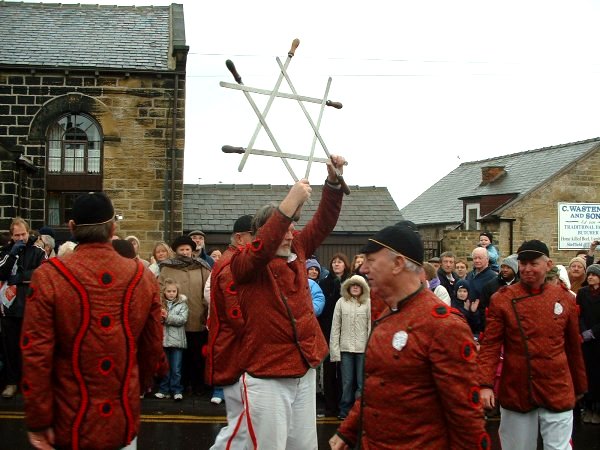
Modern sword dancers holding up a sword lock 
The central feature of the Sword Dance was an interlocking star pattern made with the swords. The group would dance around the lock with one member in the center. The lock would be placed around their neck, and the dancers would circle around the 'victim'. The dance might end with the feigned death of the 'victim'.

More sedate means of charity were also practiced like church collections and charity baskets for orphanages and neighborhood families. More than the gift giving of today, the Regency Christmastide was a season of kindness and goodwill to friends and family and charity to those in need.  

References
   
Robert Chamber’s Book of Days. (1862)  
Hazzard , Kieran. A Regency Christmas. (2013)  
Waugh, Joanna. Christmas Gift Giving. (2008)

~~~~~~~~~~~~

 Maria Grace is the author of Darcy's Decision,  The Future Mrs. Darcy, All the Appearance of Goodness, and Twelfth Night at Longbourn and Remember the Past.  Click here to find her books on Amazon. For more on her writing and other Random Bits of Fascination, visit her website. You can also like her on Facebook, follow on Twitter or email her.

Philosophy and Children’s Clothing Pt. 2

by Maria Grace

Don't miss part on of this article: Philosophy and children's clothing, pt 1

Graeme Garrard traces the origin of the Counte...While Rousseau’s Émile influenced attitudes toward childhood and childhood dress on the continent, the English ambivalence toward French ideas delayed their adoption in England. However when the Lady’s Magazine 1779 printed their (essentially plagiarized) version of Émile , the idea of simple, comfortable garments for boys gained popularity. 

 Perhaps more significantly, for mothers of boys in particular, the change in philosophy that went along with the changes in garments meant that their young sons did not make the transition from infant boys to men the moment they donned male garments. Instead of being immediately sent off to apprenticeships or boarding schools, breeched young men would enjoy a slower initiation into the world of men. Fathers would begin spending more time with them, teaching them masculine activities. A tutor might be hired to educate him or he might be sent to study a few days a week with a local vicar, curate, or other resident scholar. 

Breeching boys

1841 fashion plate boys Petit Courier des Dames During the Regency, most boys were breeched at about four years of age, several years earlier than their counterparts from the 1700’s. Child rearing ‘experts’ argued for various ages, up to age eight. They agreed, though, that a child’s size was a most important consideration. Boys who were small for their age or sickly might be breeched later. On the other hand, boys might be breeched earlier if there was concern that a parent might not live to see it.

Mothers were primarily responsible for the decision for their sons to be breeched. Fathers might exert some pressure, though, if the mother delayed the event too long.

Social class and standing would greatly influence the nature of the breeching ceremony. For the family with little means, it might be a simple affair or receiving hand-me-downs from an older brother. For the aristocracy, it might be an elaborate affair.

During the Regency, the ceremony rarely took place on the little boy’s birthday. Rather, the convenience of extended family to attend the event might be the deciding factor for timing. If the child was the heir of an upper class family, the ceremony was likely to take place at the family’s country estate rather than in a town home. Extended family and close friends, like the child’s god-parents, would be invited to attend.

Waldmüller Familie Odkolek 1826 In preparation for the ceremony, a mother would have at least one new suit of clothes made, assuming she had the means. Otherwise, hand-me-downs might be refreshed for the boy. Cotton or linen shirts, sashes, formal garments and outerwear might also be acquired. Accessories like hats, gloves, stockings and shoes could round out a little boy’s new wardrobe.

No single form existed for the breeching ceremony. Family and friends present, the little boy would make an appearance in his dress, then be led away behind a screen or to another room to change, with assistance, into his first set of distinctive male clothing. In some cases a barber might be present to give him his first masculine haircut. The shorn curls might be given to attendees as mementoes of the event.

Refreshments would be served when the newly minted young man returned in his new clothes. Well-wishers might slip coins or banknotes into his pockets as they congratulated him on his new status.

Skeleton Suits

English: Frontispiece of "Sketches by Boz...
English: Frontispiece of "Sketches by Boz" by Charles Dickens (Photo credit: Wikipedia)
A skeleton suit, one of those straight blue cloth cases in which small boys used to be confined before belts and tunics had come in … An ingenious contrivance for displaying the symmetry of a boy’s figure by fastening him into a very tight jacket, with an ornamental row of buttons over each shoulder and then buttoning his trousers over it so as to give his legs the appearance of being hooked on just under his arm pits. (Charles Dickens, Sketches by Boz, 1838-39.)

At the end of the 1700’s upper and middle class boys typically wore a skeleton suit after they were breeched and would continue in these garments until around the age of eleven.

Boy's skeleton suit, Ireland, 1789-1792, Stormont ground printed with pinned roller on cotton tabby - Patricia Harris Gallery of Textiles & Costume, Royal Ontario Museum - DSC09464 These suits featured a high button waist, long pantaloons, rather than the knee breeches worn by older men, and jackets adorned with many buttons. A blouse with an open, often elaborate collar was worn under the jacket which might be buttoned to the pants to help hold them up. Young boys might also wear pantalettes underneath with a trim or frills showing at the ankles.

Skeletons suits were cut close to the body but with far more ease in the cut than the skin tight breeches and coats worn by men. Thus, though boys today would likely find them very uncomfortable, boys of the era would consider them neither tight nor constricting. Interestingly, these garments were, due to the influence of Rousseau, considered more healthful and more moral than the more restrictive adult-like garments of early times.

The blouses for the suits were typically white and made of linen or cotton. For every day wear, the pants and jackets might be made of yellow-brown nankeen or other sturdy washable fabrics. Into the 19th century, improved dyeing techniques allowed fabrics to be more colorfast, thus more colorful skeleton suits appeared. During the Regency, dark blue was a favorite color, especially for more formal suits made of silks or velvet.

Master Lambton - Sir Thomas Lawrence On special occasions boys might wear a round straw hat with a brim and a wide ribbon band or a military style cap. Colorful sashes might also be added to the skeleton suits, tied in large poufy bows around the waist or over the shoulder. To finish their ensemble, boys would wear plain white stockings and flat shoes with a single strap over the instep, typically in black.

John Singleton Copley - Richard Heber - Google Art Project Little boys were permitted more latitude in their dress than adult men, particularly when out of the public eye. At times they were permitted to go without the jacket, presumably with some other mechanism to help hold up their pants. Sources suggest some suits had mid-calf length trousers and short or no sleeves. These were likely reserved for country wear, especially during warmer weather. It is also possible that in summer, skeleton suits might be worn without a shirt at all on very informal occasions.

A fashion conscious mother could keep up with trends in children’s clothing starting in a 1779 edition of the Lady’s Magazine which devoted a small section to children’s clothes. These fashion plates started with girls’ clothes only, but by the Regency, boy’s clothes were included as well since the same seamstresses who made ladies’ clothes also made little boy’s clothes. Children’s fashion illustrations did not appear frequently though. This irregularity had the effect of slowing the pace of change of children’s clothing since there were fewer references available for new designs.

By 1840, skeleton suits were considered old fashioned and fell out of favor. However, their popularity as children’s wear influenced men’s fashion in the following years. Since the boys who wore skeleton suits did not associate long trousers with working class garb as their fathers did, but rather with comfortable clothing for both casual and formal wear, when they came of age, they did not want to trade in their comfortable trousers for the skin tight, restrictive knee breeches their fathers wore. So trousers rose in status and esteem, and breeches slowly fell out of fashion.

References
~~~~~~~~~~~~

 Maria Grace is the author of Darcy's Decision,  The Future Mrs. Darcy, All the Appearance of Goodness, and Twelfth Night at Longbourn and Remember the Past.  Click here to find her books on Amazon. For more on her writing and other Random Bits of Fascination, visit her website. You can also like her on Facebook, follow on Twitter or email her.
Older Post ►
 

Copyright 2011 English History Fiction is proudly powered by blogger.com