Showing posts with label Henry II. Show all posts

Medieval Ireland

by E.M. Powell

Lá Fhéile Pádraig sona daoibh- Happy Saint Patrick's Day to you all!

Saint Patrick

Yes, it's the day when much of the globe celebrates all things Irish by a) donning green and b) taking leave of their senses. Fair enough. As an Irish person, it's nice to see that the small island from which I hail is so widely/wildly celebrated, and I was very pleased that I could snag today's posting date to add to the acclaim.

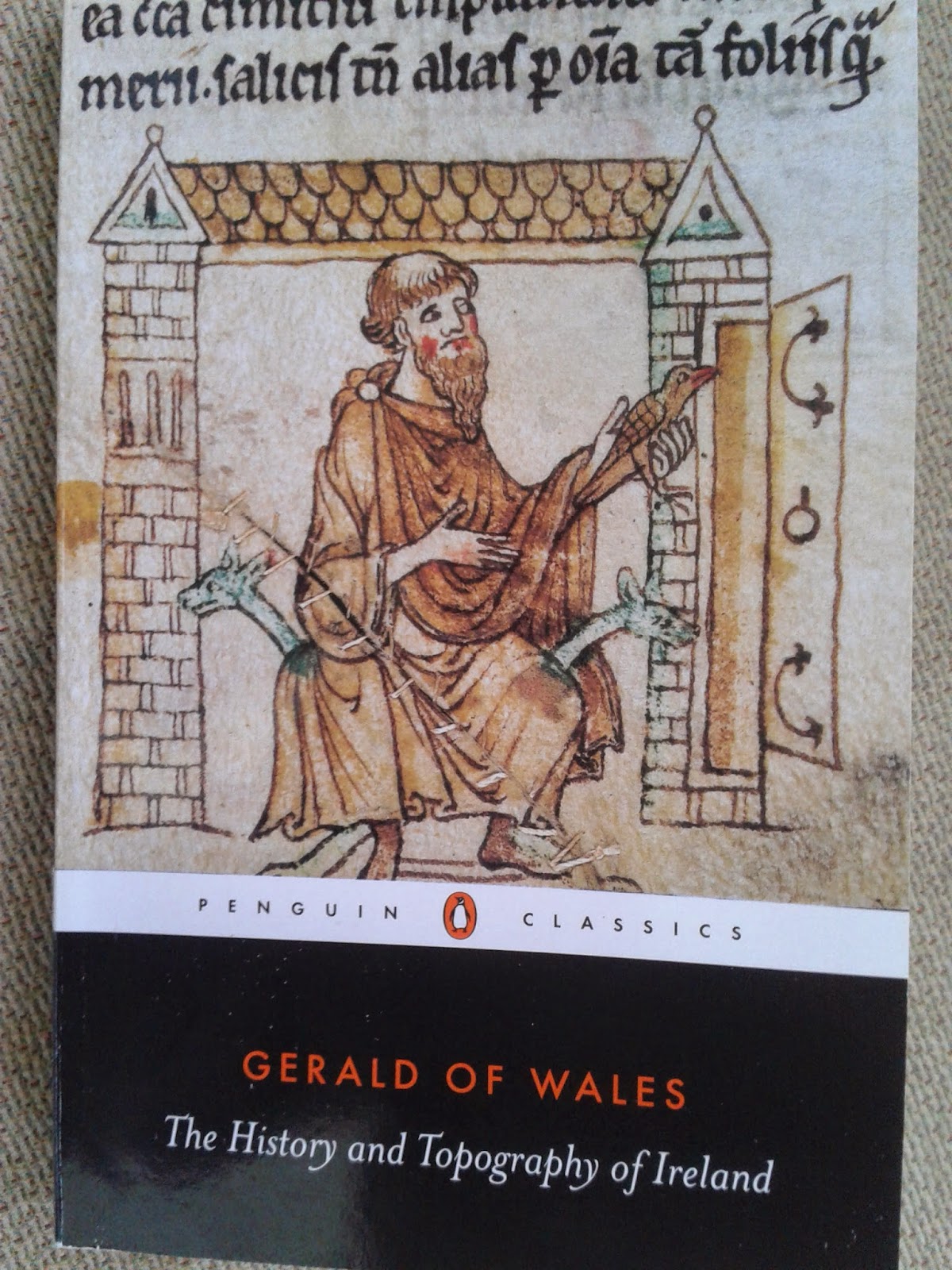
Much has been written about Ireland's history, but not many people are aware of a history of Ireland that was written in the 12th century, Topographia Hiberniae, or The History and Topography of Ireland. It was written by Gerald of Wales, a cleric and chronicler at the court of England's Henry II. (In case anyone's disappointed, please be assured that there will be snakes.)

Topographia Hiberniae

Partly Anglo-Norman and partly Welsh and a member of the hugely powerful and successful fitzGerald family, Gerald wrote seventeen books and planned several others. He wrote the Topographia following two visits to Ireland in 1183 and 1185. It is a remarkable work, shedding light on many aspects of medieval Irish life and society. However, it is at all times Gerald's light, and Gerald was on the side of the conquerors. Bearing that in mind, let's look at the Ireland of 850 years ago from a man who was there.

The island of Ireland
NASA

Gerald divided his book into three parts. the first part he called The Position of Ireland. For the medievals, Ireland was the most westerly point in the world. Sorry, Americas, but there was simply nothing else. As Gerald so beautifully puts it: " Beyond these limits, there is no land, nor is there habitation either of men or beasts- but beyond the whole horizon only the ocean flows and is borne on in boundless space." He describes Ireland as about half the size of "greater Britain and ...more round."

Atlantic Ocean, Spanish Point Co. Clare, Ireland
© Copyright Angella Streluk http://www.geograph.ie/

Ireland's natural resources greatly impressed Gerald. He writes of rivers of magnificent size, with their "abundance of fish...beautiful lakes full of fish of magnificent size...a kind of speciality here." The fertile land and the mild temperatures, along with the ease with which grass could be grown also pleased Gerald: "The grass is green in the fields in winter, just the same as in summer." But like so many visitors to Ireland, Gerald quickly found out what made all that green in the first place: the Irish weather. (Or as we natives like to call it, the rain.) Gerald is not happy: "[The harvest] can scarcely be reaped...because of the unceasing rain. For this country more than any other suffers from storms of wind and rain... There is such a plentiful supply of rain, such an ever-present overhanging of clouds and fog, that you will scarcely see even in the summer three consecutive days of really fine weather." 

Lough Leane, Killarney, Co. Kerry
© Copyright Ian S  http://www.geograph.ie/

Gerald was cheerier about the plentiful supply of birds and the lack of mammals that would pose a threat to man. He even mentions snakes, (I did promise), or rather, lack of them. He assures us that "Ireland has no serpents or snakes, toads or frogs, tortoises or scorpions."  His readers will also have been relieved to know "It has no dragons." For those of you waiting to see if Gerald has the definitive answer on Saint Patrick and the snakes issue, Gerald provides one. But you may be disappointed: "Some indulge in the pleasant conjecture that Saint Patrick...purged the island of all harmful animals. But it is more probable that from the earliest times...the island was naturally without these as well as other things." 

Snake!

The first part of the Topographia is a wonderful read, in that so much of it is recognizable as the Ireland that still exists. The second part is also remarkable but in a way that is less based in reality. In it, Gerald relates The Wonders and Miracles of Ireland.

Under Wonders, we have reports of a small island where corpses don't rot. A bearded woman with a mane on her back at the court of the King of Limerick. A priest who conversed at length with a wolf. A whale that was found with three gold teeth. Wonders, indeed, but the lake that was formed in a flood because the people were addicted to bestiality is probably the show stopper.

Wolves from a Medieval Bestiary

Moving swiftly onto Miracles, Gerald includes (among many others), the fleas banished by Saint Nannan, a cross in Dublin that speaks the truth and the inextinguishable fire of Saint Brigid. My personal favourite is The Mill that Women Do Not Enter. The mill in question was carved by Saint Féchín, and women weren't allowed in. But an archer of Hugh de Lacy (de Lacy was Henry's man) dragged a woman in "and lustfully violated her there."  Happily, according to Gerald, the archer was "stricken in his member with hell-fire in sudden vengeance and immediately began to burn throughout his whole body. He died that same night." Good for Saint Féchín, I say. 

Ruins of the 7th C St Féchín's church, Omey Island Galway, Ireland
© Copyright Oxana Maher http://www.geograph.ie/

The third part of the Topographia is where Gerald gets up close and extremely personal with the Irish people. Its title is The Inhabitants of the Country. One gets a sense of what is to come when he begins it by restating the legitimate claim that the kings of Britain have over Ireland. Following a brief mention of "beautiful, upright bodies and handsome and well-complexioned faces", there are positives no more.

Firstly, the Irish are "barbarous..and cannot be said to have any culture. they are a wild and inhospitable people...they live on beasts only and live like beasts." Secondly, they are lazy, "think that the greatest pleasure is not to work and that the greatest wealth is to enjoy liberty." Gerald really gets into his stride with the third national trait, which is incest: "This is a filthy people, wallowing in vice." Fourth has us always treacherous, and he warns "You must be more afraid of their wile than their war." The fifth is the tendency to "always carry an axe as if  it were a staff...beyond being raised a little, it inflicts a mortal blow."  

Ancient Irish Warriors- as imagined in the 1920s

If only it were some nifty axe-work we were accused of. Gerald has more. He cites the example of a new and outlandish way of confirming kingship by the Irish in Ulster (where he never went). A white mare is brought before the ruler, who has intercourse with the animal, slaughters it, then boils up the meat and has a bath in the broth, "quaffs and drinks of it...in which he is bathed...just dipping his mouth into it round about him." The Irish Church isn't spared either. Gerald despairs that all the Irish saints are "confessors and there is no martyr...to cement the foundation of the church with his blood, not a single one." 

Gerald ends by countering his earlier statements about handsome Irish people. Yes, there might be some. But he has never seen so many suffering from defects and "turn out in a horrible way."  What can the Irish expect? They are a people "that is adulterous, incestuous, unlawfully conceived and born, outside the law, and shamefully abusing nature herself in spiteful and horrible practices."

So positives no more, except for an unexpected section in the third part of the Topographia where Gerald acknowledges and praises the Irish as highly skilled and talented musicians. Mind you, even this is qualified with a statement that the Scots have probably overtaken them.

Irish Harp

What to make of the Topographia, with its praise for a country but its condemnation of a people? Well, as I remarked at the start of this post, Gerald was on the side of the invaders. And if you make those you seek to conquer less than civilized, less than human, then you have the sword of justification in your hand. It's a very powerful weapon and has never been sheathed for very long in human history. The history of Ireland is no exception. The Topographia records some sadly prescient words to that effect, attributed by Gerald to Tatheus, Archbishop of Cashel in Ireland.

The Rock of Cashel, seat of the medieval Archbishopric
Public Domain Courtesy of John Sullivan http://pdphoto.org/

Gerald was bemoaning  to Tatheus the fact that the Irish had never produced a martyr. Tatheus replied: "But now a people has come to the kingdom which knows how, and is accustomed, to make martyrs. From now on, Ireland will have its martyrs, just as other countries."

Reading them with the hindsight of eight centuries of Irish history, these words are heartbreaking. And what did Gerald make of them? They were, according to him, "sly." 

References:
Cosgrove, Art, ed: A New History of Ireland Volume II, Medieval Ireland: Oxford University Press (2008)
Duffy, Seán: Ireland in the Middle Ages: Palgrave Macmillan (1997)
Gerald of Wales: The History and Topography of Ireland: Penguin Clasics (1982)
Otway-Ruthven, A.J.: A History of Medieval Ireland: Ernest Benn Limited (1968)

All images are public domain unless otherwise stated.

~~~~~~~~~~~~~


Born and raised in the Republic of Ireland into the family of Michael Collins (the legendary revolutionary and founder of the Irish Free State), E.M. Powell is the author of medieval thrillers The Fifth Knight and The Blood of the Fifth Knight which have been #1 Amazon bestsellers in the US, the UK and Australia. She is working on the next novel in the series, Lord of Ireland, based on the Lord John's disastrous 1185 campaign in Ireland.
Find out more at www.empowell.com
Amazon.com
Amazon.co.uk
Barnes & Noble
Walmart


Giveaway: The Blood of The Fifth Knight by E.M. Powell

To celebrate its publication on January 1st 2015, E.M. Powell is giving away a signed paperback copy of The Blood of The Fifth Knight. It has already reached #1 in Historical Fiction on Amazon's UK site.

The Giveaway ends on Sunday January 04 2015. To see some more information about the book, please click HERE.

To enter the draw, comment below on this page and be sure to leave your contact details. Good luck!

The Murder of Thomas Becket

By E.M. Powell

Midwinter in England can indeed be bleak. Iron-hard frosts, smothering snow, torrential rain and gales: all can sweep down on these short days where daylight is gone by mid-afternoon. But at day's close on the twenty-ninth of December 1170, an event occurred that stunned medieval England and all of Christendom. Archbishop Thomas Becket was brutally murdered by four knights in his own cathedral at Canterbury. The knights came to Canterbury following an outburst by Henry II, king of England and much of France. It was a tragedy that had been set in motion many years before.

Canterbury Cathedral
© Shane Broderick Photography 

The son of a London merchant, Becket cut an imposing figure. He was over six feet tall (well above average for the period), with an aquiline nose, a "large brow", and "long and handsome face". He had a quick mind and a particular capacity to absorb and retain huge amounts of information. One chronicler states that he could even detect and react to distant smells and scents! Though he had stammered in his youth, he largely overcame this and was a fluent orator.

Appointed as Henry's Chancellor in 1155, Becket did not disappoint the King. He performed brilliantly in the role and the two men, Henry thirteen years younger than Becket, became extremely close. William Fitzstephen records "Never in Christian times were there two greater friends, more of one mind."

Henry makes Becket Archbishop of Canterbury
Liturgical comb c. 1200
© 2014 E.M. Powell 

One mind, perhaps, but of course Henry was king. And he was a king who was engaged in power struggles with Rome. On the death of Archbishop Theobald in 1161, Henry appointed Becket as Archbishop of Canterbury, believing Becket would simply do his bidding and act at all times on his behalf. Henry could not have been more wrong. Becket stood firm against Henry in matters of ecclesiastical law and power. Their disputes dragged on until in 1170 Henry had his son anointed as king by the Archbishop of York, a ceremony that was witnessed by ten other bishops. Becket's response? He excommunicated the bishops from the pulpit at Canterbury Cathedral on Christmas Day. When news reached Henry, he went into one of his legendary rages.

And his rages were indeed legendary. Henry could really let rip when roused. According to John of Salisbury, Henry once became so enraged during a debate about the King of Scotland that he flung off many of his clothes and started "chewing on pieces of straw." John also has Henry describing himself as "a child of anger." One of Henry's charters states that if anyone "should attempt to quash...this grant, he will incur the disfavour, anger and indignation of Almighty God and me."

Canterbury Cathedral
© Shane Broderick Photography 

So it was when Henry was informed of the news of Becket's latest actions. He "struck his hands together and exclaimed against it vehemently", his face "white with fury." His tirade against Becket was about the man's ungratefulness, too: he had raised Becket to a high position, and the only response was treachery. He worked himself up to a frightening pitch, ending with the words: "He has...shamed my realm; the grief goes to my heart, and no-one has avenged me!" Unfortunately, a group of barons who were listening took him at his word. They set off for Canterbury to avenge their king.

And who were these knights? It is unlikely they were part of Henry's intimate circle and acted to increase their favour with the king. William of Canterbury gives us their names and their descriptions. First was Reginald Fitzurse. "Urse" means "bear", and William claims the name indicated the man's savagery. Hugh de Morville's surname translates as "a village of death." William de Tracy is acknowledged as a brave fighter, but had a "sinful way of life." Richard le Bret became the Brute "on account of the depravity of his life." It was these who headed for the cathedral in which the holy man they sought was to be found.

Canterbury Cathedral
© Shane Broderick Photography 
The accounts of events from eight hundred and forty four years ago can often be sketchy. In the case of Becket's murder, we have detail upon appalling detail, as five monks were eye-witnesses to it and wrote their version.

When the knights arrived at Canterbury Cathedral, daylight was fading. They first took off their armour and went to confront Becket who was in the Episcopal Palace. They most likely had come to arrest him but Becket simply refused to comply. That did not help the situation. The knights went back out and started to put on their armour once more. The monks and clerks who were with their Archbishop were extremely concerned by now for Becket's safety. Even if no-one expected murder, they were aware that Becket could be hideously maimed or wounded in such a tense situation. No doubt Becket himself was also aware that this was now a very real possibility. The monks hustled him through to the Cathedral, though he protested throughout.

Carrying on with the rhythm of the day, the Office of Vespers was being sung, the monks voices echoing into the cathedral's high roof with the only light from candles or lamps. Such illumination would hardly have  pierced the chill darkness and cast instead deep shadows. Once the monks saw Becket, they halted their prayers, rejoicing that he was safe. It was only a temporary reprieve. As he walked to the altar, the knights burst in, armed with hatchets and an axe, Fitzurse yelling "Where is the archbishop, the traitor of the King?"

The Murder of Thomas Becket
Public Domain

Becket kept his composure, replying: "Here I am, not a traitor of the King, but a priest. Why do you seek me?" The knights were not so calm. They surrounded Becket, in a shouting, clamouring group, their lethal weapons ready and raised. Grabbing hold of Becket, they tried to manhandle him away but he grabbed for one of the stone pillars and refused to move. Then the Archbishop delivered an insult to Fitzurse, calling him a panderer or a pimp and challenged Fitzurse to kill him. This seemed to tip Fitzurse over into murderous rage, and he roared at de Tracy to strike. Becket bent his head in submission. He knew he was going to die.

Chasse showing the Martyrdom of Saint Thomas Becket c1190
© 2014 E.M. Powell 

De Tracy's first strike took off the top of Becket's skull and glanced off, injuring Brother Edward Grim. The watching appalled monks fled in panic, as Becket took another blow to the head but still remained standing. He must have been in unspeakable agony and shock, yet managed to speak for the last time: "For the name of Jesus and the good of the Church, I am ready to embrace death." De Bret thrust his sword through Becket's head with such force that the sword shattered on the altar stone. A cleric who had accompanied the knights scattered the Archbishop's brains, declaring, "He won't get up again." It was over. The knights left the cathedral and went to the Episcopal Palace, where they ransacked Becket's possessions.

Becket's body lay cooling on the altar as the traumatized monks made their way back in. Over the next few hours, people converged on the cathedral in horrified disbelief. Those who came dipped their fingers in the blood of their martyred Archbishop, daubed their clothes with it, and collected as much as they could. Terror still filled the air, with rumours flying around that the murderers were coming back to take the body, or to slay others. It was feared that the knights would defame Becket's corpse, and pull it across the city behind a horse, or display it on a gibbet. This could not be countenanced. The monks decided to bury Becket in the crypt as quickly as possible.

Canterbury Cathedral
© Shane Broderick Photography 

The miracles began that very night. A man who dipped part of his shirt into Becket's blood went home to his paralysed wife. As he wept in his telling of the murder, she asked to be washed in water containing some of the blood. She was cured immediately. A shrine was erected to Becket in the cathedral. An astonishing 100,000 people came to pray and visit Canterbury Cathedral in 1171 alone. The attributed miracles mounted up and in ten years, there were a total of 703 recorded. Becket’s intercession was in healing, casting out demons. He was prayed to by women in childbirth. When Queen Eleanor, the wife of King Henry III was expecting her fourth child, 1,000 candles were lit around Becket’s shrine.

Reliquary casket with scenes of the martyrdom c1173-80
© 2014 E.M. Powell 

And what of Henry, the king whose supposed utterance of "who will rid me of this meddlesome priest?" set the murder in motion? Henry had to give in on the matter of church courts. He also performed a number of acts of penance for the man who had once been his dear friend. The most extreme was on the streets of Canterbury on 12 July 1174, where he was scourged by eighty monks before spending the night praying at Becket’s tomb. In death, Becket had been victorious.

Canterbury Cathedral
© Shane Broderick Photography 

Saint Thomas Becket was a venerated saint for the next four hundred years. Until the arrival of another King Henry, Henry VIII. This Henry was going to take on the church. And win. When he achieved his aim of total control of the church, Henry VIII denounced Becket as a traitor. Becket’s shrine was destroyed, his bones were burned and the mention of his name was outlawed.

Canterbury Cathedral
© Shane Broderick Photography 

But Henry didn’t manage to erase the memory of Becket. People continued in their devotion to him as a saint. Today, Canterbury Cathedral still marks the place of Becket’s martyrdom and thousands continue to visit every year. Think of him today, at day’s close.

References:
Abbott, Edwin A.: St. Thomas of Canterbury: His Death and Miracles, A & C Black (1898)
Cathedral: Murder at Canterbury, BBC TV (2005)
Gervase of Canterbury: Thomas Becket's Death, from History of the Archbishops of Canterbury, Internet Medieval Sourcebook, Fordham University
Grim, Edward: The Murder of Thomas Becket, Internet Medieval Sourcebook, Fordham University
Guy, John: Thomas Becket, Penguin Books (2012)
Jones, Dan: The Plantagenets: The Kings Who Made England, William Collins, (2013)
Staunton, Michael (ed.): The Lives of Thomas Becket, Manchester University Press (2001)
Warren, W.L., Henry II, Yale University Press (2000)
Weir, Alison: Eleanor of Aquitaine: By the Wrath of God, Queen of England, Vintage Books (2007)
~~~~~~~~~~~~~~~~~

E.M. Powell is the the author of The Fifth Knight, a medieval thriller based on the murder of Thomas Becket. The sequel, The Blood of The Fifth Knight, has already reached #1 in Historical Fiction on Amazon.co.uk. It will be published by Thomas & Mercer on January 1st 2015. Her website is at www.empowell.com
Amazon.com
Amazon.co.uk

Photographer Shane Broderick specializes in studies of castles, churches and places of pilgrimage. To view more and to see his other work, please visit his Facebook Page at Shane Broderick Photography. You can also view his video here for more on Canterbury Cathedral. His photographs on this post have been used with his generous permission.


Fair Rosamund, Mistress of Henry II

By E.M. Powell

King Henry II has a deserved infamous reputation for extra-marital affairs. Documented evidence exists of several liaisons, some of which produced illegitimate offspring, with women rewarded financially for their services to the King. By far the most well-known of Henry's mistresses is Rosamund Clifford, the young woman who is often referred to as Fair Rosamund. A less flattering contemporary description comes from Gerald of Wales, Henry's acerbic chronicler, who refers to her as 'that rose of unchastity.'

Fair Rosamund
John William Waterhouse, 1916
Public Domain

Her story has been embellished by layers of myths and legends over the last eight centuries. Born to Sir Walter de Clifford, a knight who had served Henry faithfully, Rosamund may have begun her affair with Henry at a very young age. The affair became open and public in 1174 when Henry had imprisoned his wife, Eleanor of Aquitaine, for her part in a rebellion against him. Later chroniclers mistakenly claimed that Rosamund bore Henry children, but there is no evidence that she did so.

Fair Rosamund in her Bower
William Bell Scott, after 1854
Public Domain

The bearing of children is one of the tamer stories that grew up around Rosamund. Ranulf Higdon, monk of Chester, born almost a century after her death, claimed that Henry had built pleasure gardens and a labyrinth or a maze for her at Woodstock in Oxfordshire. There is no evidence of such structures at the site which is located near Blenheim Palace. The spring and pond known as Rosamund's Well were not part of the buildings at Woodstock when Rosamund lived there.

Rosamund's Well today. The well is beside the lake in Blenheim's Great Park.
  © Copyright Philip Halling Creative Commons Licence

But that didn't stop the rumour factory of popular imagination. A further embellishment was that Rosmund had been murdered by Eleanor, who had found her in the maze.

Thomas Deloney, a renowned writer of  popular ballads who died about 1600, wrote 'The Ballad of Fair Rosamond'. An edition in circulation between 1658 and 1664 is titled: 'A mournful ditty of the lady Rosamond, king Henry the seconds concubine, who was poysoned to death by Queen Elenor in Woodstocst [sic] bower near Oxford.'

Poet Samuel Daniel wrote 'The Complaint of Rosamond' in 1592 and dedicated it to his wealthy patron, Mary, Countess of Pembroke. Again, the myth of Eleanor poisoning Rosamund endures, with Rosamund uttering such lines in the poem as;

‘And after all her vile reproches used,
She forc'd me take the poyson she had brought...
The poysoon soone disperc'd through all my vaines,
Had dispossess'd my living sences quite.’

Fair Rosamund & Queen Eleanor
Edward Burne-Jones, 1861
Public Domain

There continued to be numerous references to Eleanor carrying out the ghastly murder of Rosamund. As well as poisoning, there was stabbing, burning, bleeding and doing something unmentionable with toads. In Alfred, Lord Tennyson's play, Becket, Rosamund becomes the reason for Archbishop Thomas Becket's murder in Canterbury Cathedral. 

La Normandie, Jules Janin
Public Domain

Rosamund's life certainly was cut short. She died at Godstow Nunnery in Oxford in 1176 to where she had retired. The cause of her death is not known. Henry paid for a highly decorated tomb to be erected before the altar at Godstow. The records also show Sir Walter de Clifford making grants of 'several mills and a meadow' to Godstow in memory of his wife and daughter.

Godstow Nunnery today
© Copyright Pierre Terre and licensed for reuse under  Creative Commons Licence

Henry's generosity continued after his death in 1189. Bishop Hugh of Lincoln visited in 1191 and found the tomb still adorned with silk cloths and looked after by the nuns in accordance with Henry's wishes. Bishop Hugh, however, took a rather dim view of what he found. He ordered the removal of Rosamund's tomb to the nearby cemetery for 'she was a harlot.'

Fair Rosamund
Dante Gabriel Rossetti, 1861
Public domain

It was finally destroyed during Henry VIII's Dissolution. But even Henry VIII couldn't succeed in wiping out the memory of Fair Rosamund. Her myths endure to this day.

References and sources:

Archer, T.A., rev Hallam, Elizabeth, Oxford Dictionary of National Biography (Oxford University Press 2004-2014)
British History Online: www.british-history.ac.uk
Broadside Ballads Online- from the Bodleian Library: http://ballads.bodleian.ox.ac.uk/
Daniel, Samuel: 'Delia. Contayning certayne Sonnets: vvith the complaint of Rosamond.' 
Guy, John: Thomas Becket, Penguin Books (2012)
The Poetry Foundation: www.poetryfoundation.org
Warren, W.L., Henry II, Yale University Press (2000)
Weir, Alison: Eleanor of Aquitaine: By the Wrath of God, Queen of England, Vintage Books (2007)

~~~~~~~~~~~~~

E.M. Powell is the author of The Fifth Knight, a medieval thriller based on the murder of Thomas Becket in Canterbury Cathedral in 1170.

The sequel is The Blood of The Fifth Knight, in which someone is trying to murder Henry's mistress, the Fair Rosamund. It will be released by Thomas & Mercer on 01.01.2015.
It is available to UK customers on Kindle First from 1-31st December 2014.


Visit her website at www.empowell.com


Alice Capet: The Almost-Queen of England

by Lauren Johnson

Philip Augustus and Richard I
Winter 1191. The armies of two mighty Christian kings jostled for space in their encampment on the island of Sicily, en route to the Crusades. Months had passed, and both monarchs and soldiers had grown restless. Everyone awaited the coming spring and conditions safe enough to sail on to the Holy Land. None were more eager to depart than their commanders: the English King Richard; the French King Philip Augustus; and their reluctant host, the diminutive King Tancred of Sicily. Once so close that they had shared bed and board, Richard and Philip’s relationship had become uneasy during their time in Sicily. Rumours had reached Philip that Richard planned to betray a decades-old alliance between their families – a union that would have seen him marry Philip’s sister Alice. Now there were reports that a princess of Navarre was on her way with Richard’s mother, the indomitable Eleanor of Aquitaine, to claim the English king’s hand instead. Philip was incensed. ‘If he does put (Alice) aside and marry another woman,’ he declared, ‘I will be the enemy of him and his so long as I live.’

Richard I
Characteristically, Philip chose to force the issue by manipulative diplomatic means rather than open conflict. He went to Tancred, accusing Richard of plotting to seize Sicily for his own family. When Richard learnt of this he – equally characteristically – forced a confrontation, in which the French king demanded, in a refrain that had become a standard of Anglo-French bargaining over the past ten years, that Richard finally fulfill his promise and marry his sister. It was then that Richard made a shocking accusation.

‘He could never take Philip’s sister as wife,’ he said, ‘for the king of England, his father, had known her, and got a son from her, and to this end Richard could produce witnesses.’

The report was staggering and, for the French king, mortifying. Unwilling for the salacious details of his sister’s scandal to be publicly broadcast by Richard’s witnesses, Philip swiftly signed a treaty that left Richard free to marry whoever he wanted and handed over the right to long-contested border territories in France. In this humiliating concession, the seeds were sown for future discord between Philip and Richard, which would lead to the failure of their crusade and a rebellion in England that almost lost Richard his kingdom.

The disintegration of Richard and Philip’s alliance is a story that has often been retold. But what of the fate of the woman at the heart of this conflict? The princess who had allegedly slept with her fiancé’s father in defiance of years of carefully nurtured diplomatic arrangements? Who was Alice of France? And did she really risk her marriage, and her lands, for lust?

Henry II
Like so many medieval women – even princesses – Alice’s life is an unpicked patchwork where stark political facts sit alongside substantial lacunae of information. She was born in 1159 and betrothed to Richard when both were still in their nurseries. At that time it served the interests of their fathers (Louis VII of France and Henry II of England) to make peace, ending another round of fruitless competition between their territories. Although he was King of the English, Henry II’s realm stretched far beyond the island of Britain. By right of family and conquest, he held vast swathes of what we would now consider western France, while Louis had to be content with a powerbase to the east.

France 1154
Alice’s marriage was thus negotiated from the very beginning as a political alliance for the benefit of others. This was not unusual, and indeed Richard and Alice’s betrothal was mirrored in that of their elder siblings: Prince Henry of England and Margaret of France. However, Richard and Alice’s relationship was in other ways very different. For while Henry and Margaret spent time in one another’s households, had a child and built up a faction together over their many years of marriage, Richard and Alice remained unwed, and were rarely in each other’s company. At the age of fifteen Richard was made duke of Aquitaine in what is now southern France, and was based there until his accession as King of England in 1189. Alice, meanwhile, was kept in a sort of roving dormitory of princesses, travelling with Richard’s mother, Queen Eleanor, and various other royal children – both Eleanor’s own, and the intended fiancées of her sons. In this age of itinerant kingship, when the King of the English was also Duke of Anjou and Normandy (not to mention many other smaller continental territories), Alice’s childhood would have been spent constantly on the move. Eleanor often travelled with her husband and children, even crossing the treacherous English Channel while pregnant in 1157.

During her childhood, Alice was treated as befitted her royal status, but little attention was paid to her by contemporaries. It is not even clear exactly which territories or fortifications made up her dowry, and during the Plantagenet rebellions of the 1170s no chronicler mentions her playing any part. Alice’s status – and her future – changed in 1183, when she was in her early twenties. A feud within the English royal family had escalated into armed rebellion and Alice’s brother-in-law Prince Henry died still fighting his father the King. In the aftermath, the prince’s widow, Alice’s sister Margaret, handed her own dowry over to her little sister in exchange for a pension. Alice now held the right to a vital frontier territory between Normandy and France called the Vexin, making her extremely useful to whichever party had possession of her – a fact that Henry II was all too aware of.

The Vexin

From this moment onwards, Alice’s fate was sealed. As long as she was in Henry’s control, so too was the Vexin. If she married Richard, the King would lose not only his ward but also his land – and to a son whose loyalty was highly suspect, for it often seemed that Richard was closer to the King of France than to his father. Despite almost annual French demands for Alice and Richard’s marriage to take place, Alice remained firmly under Henry’s authority, and decidedly unwed.

It is tempting at first glance to see Henry’s refusal to marry off Alice as proof of the affair, which his son so humiliatingly made public in 1191. However, by 1183 whatever relationship they had had was several years old (perhaps even over), and while he consistently delayed her wedding day, the King proved all too willing to use Alice’s marriage as pragmatically as he used his children’s inheritances. To him they were all pawns in an international game of chess, and only he got to move the pieces. In fact, only one year after Alice took hold of the Vexin, Henry was plotting to transfer her marriage from the faithless Richard to his favourite son, John. Alice’s brother Philip, now King of France in his own right, protested and increased pressure on Henry for the marriage with Richard to take place as soon as possible. Henry repeated his assurance that it would, but made no moves whatsoever. This was a pattern Henry repeated throughout his custody of Alice: in 1177 at the treaty of Ivry; in 1180 at Gisors; at Bonmoulins in 1188. And it was to be a foundless promise Richard himself would repeat as king.

To view Henry’s willingness to barter with Alice’s marriage as evidence against the alleged relationship would be to misunderstand Henry’s character, and to impose sentimentality on a man of undoubted passion, but little romantic sensibility. Even those family members Henry loved best were still viewed by him as bargaining chips or potential rivals. Some panegyrists of the ‘father of common law’ have insisted that Henry would not have ravished his own ward, but his sexual history suggests the opposite. He was a known womaniser who fathered several bastards – and not merely with lowborn women, but with those of high rank too. One of these illegitimate children, William Longspée, was probably the product of an affair with Ida de Tosny, who later married the Earl of Norfok – she received a manor in Oxfordshire ‘for her service’. His was a libidinous court, with prostitutes (meretrices) provided to meet royal needs in both England and Normandy.

So much for Henry. But would Alice really risk her reputation and her future for a king 26 years her senior? To answer this we need to look at the most likely period when their relationship began, when Alice was still in her teens.

In 1176 Henry’s most famous mistress, Rosamund Clifford died (yes, she of the legendary labyrinth, purportedly murdered by Queen Eleanor – all stories written for the first time centuries after her death). In that year, Alice was about seventeen, a perfect age for marriage – and, of course, to arouse the sexual interest of a man like Henry II.

It seems more than coincidental that it was also in 1176 that Henry appealed to the Pope to grant an annulment of his marriage to Eleanor of Aquitaine. Eleanor was then in her mid-fifties, and beyond further child-bearing. Alice, on the other hand, was clearly old enough to have children, and with her royal connections not an unsuitable match for the King.

Further evidence is provided by the sudden arrival of Peter, cardinal of St Chrysogonus, who came from France shortly afterwards with a papal threat: if Henry did not arrange the marriage of Alice and Richard immediately, he would be placed under interdict. This was the worst punishment the Church could hand out, since it meant the removal of all religious rites for Henry’s subjects – no baptisms, marriages or last rites could be given under an interdict. This was a bold step for the King of France and the Pope to take if Henry’s only crime was hesitance. It seems much more likely that they had heard whispers of Henry’s incestuous liaison with his son’s intended. Unsurprisingly, Henry’s requested annulment was not granted. Equally unsurprisingly, no marriage went ahead with Richard either.

Under the circumstances, it is entirely possible that Alice entered a sexual relationship in the belief that Henry’s annulment would be granted and any children accidentally born to them could be legitimated after their subsequent marriage. She is unlikely to have felt much loyalty to the little-known Richard, and diplomatic betrothals made in infancy were often broken in later years. It need not be the case, either, that Alice was an unwilling victim of a sexually voracious king. Sexual desire in young women existed in the twelfth century just as it does today – medieval writers made much of the lechery of females, a convenient cover for both genders’ sexual incontinence. It is entirely believable that, in spite of the risks, Alice was attracted to the powerful and authoritative Henry II – and equally possible that she would act on that sexual interest.

It was her misfortune that whatever intentions or affection Henry may have had for her, the annulment was not granted. And since the King could not allow her to marry Richard – nor, when he had his free will, was Richard inclined to do so – Alice had to remain a virtual prisoner of her inheritance.

During the 1180s Alice’s name appears in royal accounts: some linens for her use here, some furs and scarlet there. Her name was connected to that of Isabel of Gloucester, Prince John’s future wife, so it is likely that she was then back among the other noble females. In spring 1190 she crossed the Channel with Queen Eleanor, curiously, at Richard’s request. By this time Richard was far down the path of arranging his marriage to Berengaria of Navarre, so why did he insist that Alice was with his mother? Perhaps he wanted to keep an eye on her, for she was still politically important as a French princess and as heiress of the Vexin. She was installed in a Normandy castle, and there she was to remain for the next half-decade.

We do not know when she learnt of the revelation of her scandal. Philip was in no hurry to regain control over her, suggesting that he was as angry with her as he was humiliated by Richard. One might imagine that with Richard married to another woman, Alice would be free from Plantagenet intriguing. But during Prince John’s attempted seizure of England in Richard’s absence, Alice’s marriage again reared its head – now John’s marriage to Alice was the price of French support for the rebellion. (This despite the fact John was already married.) With Richard’s return from overseas in 1194, John’s plot was crushed, and Alice’s usefulness as a bargaining chip brought to an end. In 1195, having finally taken guardianship of his sister, King Philip married her off hurriedly to a border lord, the Count of Ponthieu. No doubt Philip had it in mind to annex Ponthieu within his own lands at some later date, using Alice’s claim as his justification. In fact Alice’s daughter Marie succeeded to the county, and then her granddaughter after that.

The bare bones of Alice’s history – and bare bones is all we have – make her seem more like a pinball than a princess, reeling from one potential union and alliance to another: she’ll marry Richard – no John – no Richard again – or is it Henry himself who’ll be her husband? Her claim to key territories seems to have mattered more than her person in the minds of both her French family and Henry’s. She lived with the Plantagenets for over thirty years, yet ended her days not as Queen of England, but as countess of a small county near France. No chronicler recorded the date of her death, or anything of her subsequent life after 1195.

However, Alice’s entanglement with the Plantagenet line did not end there. Alice’s great granddaughter was a princess of Castile, named Eleanor. That princess married a King of England, and their descendants ruled the country for centuries long after Richard, Henry and John were encased in their stone tombs. Alice Capet, the woman who should have been Queen of England, and the focus of decades of political turmoil, eventually found her way into English history.

Brief Bibliography

Christopher Harper-Bill, Nicholas Vincent (eds.), Henry II: New Interpretations (Boydell Press, 2007)
Frank McLynn, Lionheart and Lackland: King Richard, King John and the Wars of Conquest (Jonathan Cape, 2006)
Elizabeth Thomas, The Woman who Should Have Been Queen: Alys Capet and the Angevin Kings, paper presented at the International Medieval Congress (Leeds, 2008)
Bonnie Wheeler and John Carmi Parsons (eds.), Eleanor of Aquitaine: Lord and Lady (Palgrave Macmillan, 2008)

~~~~~~~~~~~~~

Lauren Johnson is an author and historian based in London, UK. She is the Research Manager for Past Pleasures, a costumed interpretation company which works daily at heritage sites including the Tower of London and Hampton Court Palace.

Her debut novel, The Arrow of Sherwood is an origin story of Robin Hood, rooting the myth in the brutal, complex reality of the twelfth century. It is published by Pen & Sword Fiction and now available as an eBook.

Lauren is currently working on a history of the year 1509 (when Henry VIII came to the throne), to be published by Head of Zeus in 2016.

Amazon US
Amazon UK


Older Post ►
 

Copyright 2011 English History Fiction is proudly powered by blogger.com